Luciano Kay
I research how emerging technologies move from research to commercialization, how markets and industries form around them, and how organizations navigate the resulting change. My work spans research, consulting, and entrepreneurship, helping clients make sense of technological, competitive, and policy uncertainty. Ph.D. in Public Policy. Based in Palo Alto, California.

Quantum technology research – I worked extensively with private clients to investigate quantum computing, sensing, and communication technologies, their applications, and emerging markets. This included mapping industry players, conducting company research, and analyzing technology trends and competitive dynamics. Photo credit: Shutterstock
Work My work has spanned academic research, consulting, and entrepreneurship across many domains of innovation. The through line has been a consistent emphasis on rigor and analysis that is genuinely useful.
Since 2017, I work as an independent research consultant for startups, tech companies, global enterprises, investors, universities, and public-sector organizations. My work helps clients understand emerging tech, markets, competitors, and innovation ecosystems so they can make better strategic, investment, and policy decisions. More about my consulting work.
The projects I work on are diverse. They range from investigating generative AI and quantum computing markets worldwide to estimating demand for aerospace and defense technologies, analyzing climate-related risks in financial markets, evaluating innovation and entrepreneurship programs, conducting competitive intelligence, sizing markets, forecasting trends, and mapping technology landscapes. Depending on the engagement, my work may combine market research, ecosystem analysis, company research, due diligence, demand forecasting, technology assessment, and policy analysis.
The industries and verticals change, but the underlying challenge is usually the same: helping organizations make sense of technological and market uncertainty in ways that are genuinely useful for strategy, investment, and policy decisions.
I spent more than a decade conducting academic research on innovation, emerging technologies, and economic development at Georgia Tech and the University of California, Santa Barbara. My work examined how new technologies are developed, commercialized, and governed, with a particular focus on nanotechnology and other emerging technologies, innovation policy, and the strategies organizations use to create and capture value from technological change.
Along the way, I published research in academic journals, books, policy reports, and other outlets; presented at conferences and invited talks in the United States and abroad; served as a reviewer for academic journals; and contributed expert input to initiatives such as the U.S. National Nanotechnology Initiative's PCAST report to the President and Congress.
My research relied heavily on quantitative and computational methods, including bibliometric analysis, patent analytics, network analysis, data mining, and large-scale technology mapping. Some of the tools, databases, and methods I developed during this period later became the foundation for my consulting and entrepreneurial work.
I also taught and co-instructed in courses in innovation, management, and public policy in both the United States and Argentina.
I've started several ventures over the course of my career. For example, in 2016, I launched Innovation Pulse, an analytics and software startup focused on patent intelligence and alternative data. Software I developed there won first prize in the OECD–EUIPO Big Data Challenge. Earlier, I founded Manavell Websites, a software factory business serving clients across Latin America, the United States, and Europe.
More recently, I've been building software and communities around entrepreneurship, research, and artificial intelligence. I founded Negocios Argentina, a distributed entrepreneurship organization with more than 28,000 members across Argentina and Latin America. I also experiment with AI-powered applications, research tools, and data platforms designed to help entrepreneurs, researchers, and organizations make better use of information. Formar Equipo, another project I've built, has connected hundreds of entrepreneurs who seek cofounders for their projects.
Before pursuing my Ph.D., I also worked in a variety of professional roles in Argentina, including management consulting, software implementation, financial analysis, banking, university teaching, and research. Those experiences gave me early exposure to how organizations operate and make decisions, complementing the research, policy, and technology perspectives that would later define much of my career.
All that work required and produced a wide range of methods and tools to improve my work and the work of other professionals. My work combined all sorts of quantitative, qualitative, and mixed-method approaches to research and analysis, in addition to the development of diverse types of pipelines for data development. Depending on the project, I may draw from market research, competitive intelligence, technology assessment, policy analysis, case studies, interviews, statistical analysis, or large-scale data analysis.
A significant part of my work has involved bibliometric and patent analysis, including the construction of large datasets, technology landscapes, and visualizations that help reveal patterns in innovation and technological change. I've worked independently and with colleagues to build patent and company databases, developed data-mining and analytics tools, and used techniques such as network analysis, text mining, and technology mapping to study emerging industries and innovation systems. My work on patent overlay mapping and other approaches to visualizing technological distance and technological evolution is a good example.
My research and consulting projects have spanned a broad range of domains, including artificial intelligence, quantum computing, nanotechnology, aerospace, climate technologies, advanced manufacturing, defense technologies, life sciences, consumer products, and digital platforms. Across these areas, I've always been particularly interested in how technologies move from research to commercialization, how markets and ecosystems emerge around them, how organizations compete and collaborate, and how policy influences innovation and economic development.

Prizes as incentives to promote investment and innovation – My book Technological Innovation and Prize Incentives. The Google Lunar X Prize and Other Aerospace Competitions. explores the relationship between prize competitions, economic impact and broader innovation ecosystems. Source: Kay et al. (2014) / Wired UK.
Timeline My career has moved through academic research, consulting, and entrepreneurship, but the underlying interest has stayed consistent: understanding how business, technology, and public policy shape innovation and economic change.
I work as an independent research consultant with startups, tech companies, and global enterprise clients. For more than twenty-five years, I've been researching companies, markets, innovation systems, and emerging technologies at the intersection of business strategy, economic development, and science and technology policy. The focus is understanding how new technologies evolve, how markets form around them, and how organizations navigate the resulting changes.
I investigated generative AI and quantum computing markets and companies in the United States and globally, mapped high-performance computing data centers, and modeled the economics and broader impact of quantum computing technologies. I also analyzed climate-related effects on financial markets, estimated market size and demand for military drone refrigeration subsystems for a deep-tech startup, conducted market, brand, consumer, and trend analysis for a global appliances company, and modeled the economic impact of enterprise software products to support large-scale commercial deployments. My work frequently combined market research, competitive intelligence, technology landscape analysis, demand forecasting, and investment-related research.
My research spans domains including artificial intelligence, quantum computing, climate technology, aerospace, advanced manufacturing, nanotechnology, and other emerging technology fields. Across these areas, I investigate the impact of technological change, the structure and evolution of markets and innovation ecosystems, the competitive positioning of companies, and the policy and economic factors that shape technology development and commercialization.
I lead Negocios Argentina, a distributed entrepreneurship organization I founded in 2022. It currently has more than 28,000 members focused on entrepreneurship, technology, and business development in Argentina and Latin America.
I founded and led a small research and advisory firm serving startups, other tech companies, global enterprises, and investors across generative AI, climate tech, aerospace, pharmaceutical and life sciences, IoT, Web3, and premium consumer technologies. The firm's work spanned market sizing, impact assessments, competitive and ecosystem landscape mapping, company research and due diligence, investment evaluation, and analysis of technology adoption and growth trends. A representative engagement: I modeled the economic impact of a SaaS sales-enablement tool from product features and industry-wide performance metrics, supporting a deal to deploy tens of thousands of licenses at a Fortune 500 company.
Between 2016 and 2019, I founded and led Innovation Pulse, an analytics and software startup focused on patent intelligence and alternative data. Software I developed won first prize in the First Big Data Challenge organized by the Organisation for Economic Co-operation and Development (OECD) and the European Union Intellectual Property Office (EUIPO).
I previously served as a Research Associate and Assistant Researcher at the Institute for Social, Behavioral and Economic Research (ISBER) at the University of California, Santa Barbara (UCSB), and earlier led the quantitative research effort at UCSB's Center for Nanotechnology in Society. During this period, I recruited research assistants, designed patent-data pipelines, developed software and interfaces that queried a patent database covering more than 90 million records, and built large-scale company and technology datasets (small for other disciplines, decent for this kind of analysis).
My research at UCSB focused on innovation activities, corporate strategies, and public policy related to emerging technologies. I examined the development and commercialization of nanotechnology, national innovation strategies, and science and technology policies, with particular attention to Asia—especially China—and Latin America.
My work also involved the development of data-mining methods, patent analytics tools, and large-scale visualizations of technology and innovation landscapes. You may learn more about my work on bibliometric and patent analysis here. More broadly, my research has addressed economic development, science and technology policy, innovation systems, and the societal and economic implications of emerging technologies.
From 2011 to 2012, I worked as a Postdoctoral Fellow with Georgia Tech's Program in Science, Technology and Innovation Policy (STIP) and co-instructed Geography of Innovation (PUBP 6741) at the School of Public Policy. During that period, I conducted research on the U.S. Nanoscale Science and Engineering Centers (NSEC) program, knowledge acquisition and dissemination processes in Malaysia's economy, and other projects related to innovation, economic development, and technology policy.
Between 2007 and 2011, I worked as a Graduate Research Assistant at STIP, where I investigated policy issues related to economic development, science and technology, innovation, and emerging technologies across the United States, Latin America, Europe, and Asia using quantitative, qualitative, and mixed methods.
My doctoral dissertation, titled How do prizes induce innovation? Learning from the Google Lunar X Prize, became the foundation for a broader research agenda on innovation prizes and grand challenges. My research investigated how prizes induce innovation, the motivations and R&D activities of participants, the technological outputs generated by competitors, and the influence of institutional and market contexts on competition outcomes. This work was supported through competitive grants from the U.S. National Science Foundation and the IBM Center for the Business of Government. You may read this article for more about prizes.
My work on innovation prizes has been published in journal articles, policy reports, and the book Technological Innovation and Prize Incentives. The Google Lunar X Prize and Other Aerospace Competitions. It also explored the relationship between prize competitions and broader innovation ecosystems.
I presented at conferences and delivered invited talks in the United States and abroad. I published scholarly work in leading peer-reviewed journals, including R&D Management, Journal of Technology Transfer, and Minerva, as well as books, book chapters, policy reports, and other professional publications. I have also provided expert input for policy initiatives such as the congressionally mandated U.S. National Nanotechnology Initiative PCAST report to the President and Congress.
In 2009, I received the William H. Read Award for Outstanding Public Policy Student from the Georgia Institute of Technology.
Between 2006 and 2007, I worked as a Graduate Research Assistant with Georgia Tech's Research Value Mapping Program (RVM), where I investigated university-industry relationships involving small and medium-sized enterprises (SMEs).
Before beginning my Ph.D. studies in the United States, I held positions in both the private and academic sectors in Argentina. Between 1998 and 2006, I worked as a researcher, lecturer, consultant, entrepreneur, and financial analyst. I taught undergraduate courses in management, economics, strategic management, and entrepreneurship; conducted research on SME clusters, innovation systems, and regional development; advised organizations on reorganization and software implementation; and worked in financial analysis and business banking. In 2001, I founded Manavell Websites, an internet business serving clients across Latin America, the United States, and Europe.
I also studied management and earned a Licentiate degree in Management from Universidad Nacional del Litoral (Santa Fe, Argentina). My thesis examined the policies Italy implemented in the postwar period to support its SMEs and drew lessons for Argentina. Before this, I obtained a Mechanical-Electrical Technician degree from Escuela Industrial Superior (Santa Fe, Argentina). My final project, developed with longtime friends, was a feasibility study for a city-scale biodigester to process waste and generate electricity and other byproducts.
I was born and raised in Santa Fe, Argentina.
Contact Please use lucho@scoutaction.com to send me a message. You may also connect via LinkedIn to keep in touch (please introduce yourself: Have we met at a conference? Is there any collaboration opportunity? Is your work related to my projects?)
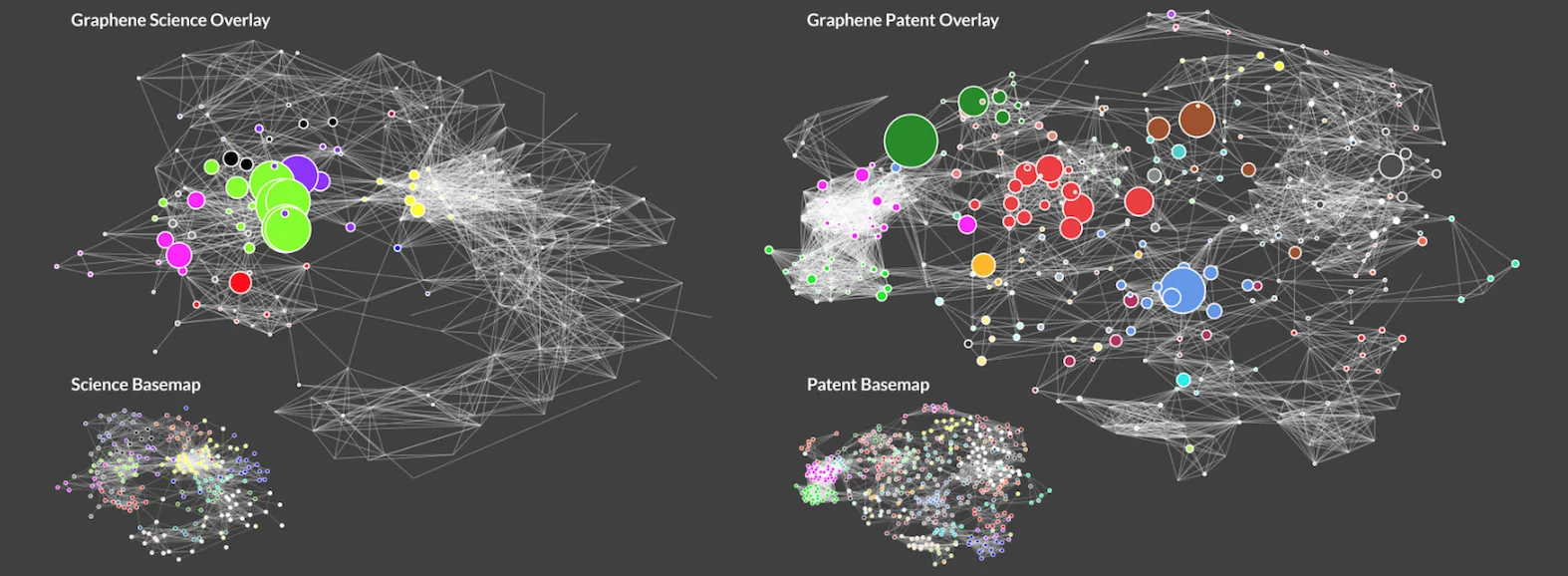
Mapping graphene science and development – We developed a patent map overlay methodology used later along with the science maps by Rafols, Porter and Leydesdorff (2010) to investigate Graphene R&D. Read more about patent maps here. This visualization is part of: Places & Spaces: Mapping Science, edited by Katy Börner and Samuel Mills. Source: https://scimaps.org